
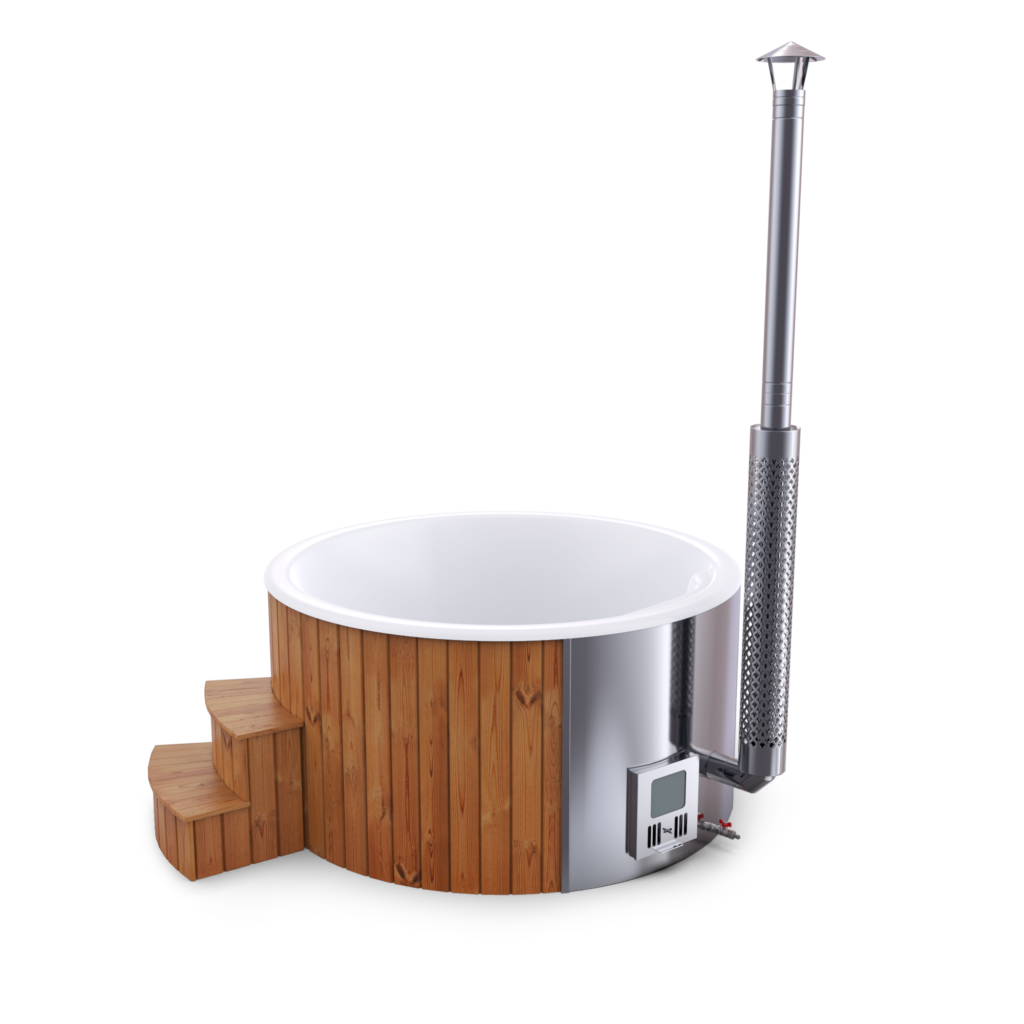
If you sell hot tubs – as a garden centre, pool and spa shop, holiday-home developer or online retailer – the wholesale price you pay decides your margin. Yet two quotes for a “6-person wooden hot tub” can differ by a surprising amount. This guide explains what actually drives hot tub wholesale prices, how factory-direct pricing differs from buying through a distributor, and how to compare offers fairly.
Looking for which models to stock? Read our companion article Wholesale Hot Tubs for European Distributors. This article focuses on price.

Factory-direct vs wholesale vs retail: three price levels
Before comparing numbers, make sure you are comparing the same level of the supply chain:
- Factory-direct (manufacturer) price – what the producer charges dealers and distributors. This is the lowest price but usually comes with order volume requirements and ex-works or FCA delivery terms.
- Wholesale (distributor) price – a regional distributor buys from the factory, stores stock locally and resells to smaller dealers. You pay more per unit but can order smaller quantities with shorter delivery.
- Retail price – what the end customer pays, including installation, VAT and the dealer’s margin.
Buying directly from a manufacturer such as a Lithuanian SPA manufacturer removes one layer of margin, which is why many European dealers now source factory-direct.
The 7 factors that set a wholesale hot tub price
1. Liner material: acrylic vs fiberglass vs wood
The inner shell is one of the biggest cost items. Acrylic liners are thicker and more resistant to chemicals and scratches, so they cost more than fiberglass. Classic all-wood tubs without a liner are cheaper to make but require more maintenance from the end customer. Our Acrylic vs Wooden Hot Tubs guide for wholesale buyers explains the trade-offs in detail.
2. Heater type and power
An integrated stainless steel stove, an external stove, a side-mounted Horizon heater or an electric heater all carry different costs. Higher power (for example 30–35 kW instead of 20 kW) means faster heating and a higher price. Stainless steel grade matters too – 304 grade is the standard for durable heaters.
3. Size and shape
Larger tubs need more material and more labour. Square and specialised shapes, such as square hot tubs and ofuro baths, are usually priced higher than standard round models of a similar volume.

4. Cladding
Spruce is the entry option. Thermowood, larch, red cedar and WPC composites cost more but sell better in the premium segment. Many dealers stock one or two best-selling cladding options and order the rest to customer request.
5. Options and extras
Hydro-massage and air-bubble systems, LED lights, filters, covers and electric heaters can add a significant amount to the base price. For dealers this is good news: extras usually carry a higher margin than the tub itself, so bundle packages are worth planning.
6. Order volume and mix
Wholesale price tiers usually depend on how many units you order at once and whether they are shipped together. A full truck load lowers the per-unit transport cost considerably compared with shipping one or two tubs.
7. Delivery terms and logistics
Always check the Incoterms. An ex-works (EXW) price looks lower, but you then pay for loading, transport, insurance and customs yourself. A delivered (DAP) price includes transport to your warehouse. Hot tubs are bulky, so transport can be a noticeable share of the landed cost – especially outside the EU.
Private label hot tubs: what changes in price?
More dealers now want to sell under their own brand. A private label spa brand manufacturer produces tubs to your specification and marks them with your logo. Expect these differences compared with standard wholesale:
- Higher minimum order quantities, as production must be planned separately.
- One-off costs for branding, packaging or custom moulds.
- Longer lead times for the first order.
- In return, more control over your product range and no direct price comparison with other dealers selling the same brand.
See our overview of top wholesale hot tubs for models that are often used as a base for private label.
How to compare two wholesale offers
When you receive quotes from different suppliers, compare them line by line:
- Same specification? Liner thickness, heater power and steel grade, cladding wood, and insulation.
- What is in the standard package? Steps, chimney, thermometer, drain tap and insulation are sometimes included and sometimes charged extra.
- Delivery terms. Convert every offer to a landed cost at your warehouse.
- Warranty and spare parts. A cheap tub without available parts costs you more in after-sales service.
- Certification. Make sure the products meet European safety and quality standards and come with proper documentation.
- Lead time. A slightly higher price with a reliable short lead time can earn more in the spring season than a cheap tub that arrives in July.

Tips to protect your margin
- Order before the season: winter and early spring orders are easier for factories to plan.
- Consolidate orders into full truck loads to lower transport cost per unit.
- Stock a simple core range – one round, one square, one compact model – and sell options as upgrades.
- Offer installation and accessories (covers, chemicals, filters) to raise the average order value.
For a wider market view, read The European Hot Tub Market in 2026 and our list of hot tub suppliers in Europe.
Frequently asked questions
Why are wholesale hot tub prices so different between suppliers?
Mostly because the specifications differ: liner material and thickness, heater power, cladding wood, included accessories and delivery terms. Compare landed cost for an identical configuration.
Is factory-direct always cheaper than buying from a distributor?
Per unit, usually yes. But a distributor may offer smaller orders, local stock and faster delivery, which can be worth more for small dealers.
Can I buy wholesale hot tubs in small quantities?
Many manufacturers accept mixed orders of different models. Ask about price tiers and whether several models can be combined in one shipment.
Do private label hot tubs cost more?
The unit price can be similar, but expect higher minimum orders, one-off branding costs and longer first lead times.
Want current dealer pricing? Browse our wholesale hot tubs and request a wholesale quote – we will send prices for your exact configuration and delivery location.