
Ask any distributor who has been selling hot tubs for more than a couple of seasons and they’ll tell you the same thing: the money isn’t made on the cheapest quote. It’s made on the tub that doesn’t come back under warranty, arrives on time, and sells through before the season ends.
That matters more than ever right now. Europe is the second-biggest hot tub market on the planet — worth somewhere around €1.5 billion in 2025, roughly a quarter of global sales. Hotels are fitting tubs to win bookings, glamping sites treat them as the headline amenity, and homeowners have decided a wood-fired soak beats another streaming subscription. Demand is there. The question is what you put in your catalogue and who you buy it from.
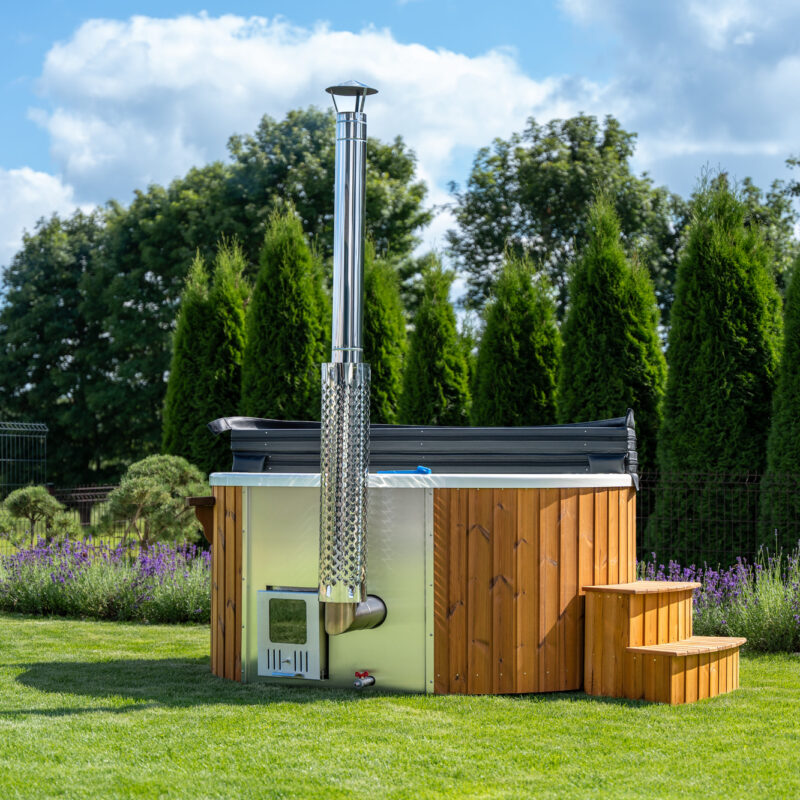
This guide is written for trade buyers — distributors, dealers, hotel groups, glamping operators. Below are the ten hot tub types worth stocking in 2026, then the commercial checklist that actually decides whether a supplier is worth a purchase order. If you’re buying a single tub for your own garden, the same logic still holds; you’ll just skip the wholesale bits.
What’s Actually Changed in 2026
A few years ago you could shift almost any barrel-shaped wooden tub. Not anymore. Three things have moved the market:
- Buyers have traded up. Cheap all-timber tubs that rot and leak are losing ground to thermowood cladding and lined shells. Customers want the wood look without the annual grief.
- Hospitality buys in volume. Resorts and rental operators order in batches and expect commercial-grade durability, not a consumer product that folds after two seasons of heavy use.
- Nobody trusts a bargain from nowhere. After a few years of shipping headaches, buyers want CE paperwork, real lead times and spare parts they can actually get hold of.
Stock the right mix and the margins here are genuinely good. Fill your warehouse with no-name imports and no parts pipeline, and every warranty claim lands on your desk, not the factory’s.
The 10 Hot Tub Types Worth Stocking in 2026
Prices are rough retail guides in EUR. Your wholesale cost sits below this and moves with volume, spec and currency, so treat the numbers as a starting point and confirm live quotes before you commit.
1. Lined Round Tub with Thermowood Cladding — Your Hero Product
If you only stock one thing, make it this. A fibreglass or acrylic inner shell kills off the two problems that plague cheap tubs — leaks and grimy wood — while the thermowood exterior keeps the natural look people pay for. An internal stainless stove heats it fast.
- Pros: Low upkeep, easy to clean, long life, holds resale value
- Cons: Heavier than all-wood; costs more than basic spruce
- Price: €3,500–6,500
- Best for: The catalogue staple; rental and glamping operators who need it to survive constant use
2. Classic All-Timber Spruce Tub — The Entry Point
The traditional Scandinavian barrel, built entirely from wood with a submerged or external stove. It’s what most people picture when they think “wood-fired hot tub,” and it wins on price.
- Pros: Cheapest way in, great wood aroma, heats quickly, ships flat
- Cons: Spruce wants oiling every year or it rots; shorter life than a lined tub
- Price: €2,000–3,500
- Best for: Budget-focused retail and customers who specifically want the old-school look
3. Premium Thermowood Tub with Internal Stainless Stove
Same idea as your hero product, dialled up. Heat-treated thermowood barely moves, shrugs off rot, and a 304 stainless stove gets you to temperature without burning through a forest.
- Pros: Built to last, premium feel, minimal maintenance
- Cons: Higher ticket; the cladding still needs the occasional bit of care
- Price: €4,500–7,500
- Best for: Upmarket dealers, boutique hotels, colder markets
4. Wood-Fired Jacuzzi with Jets and Massage
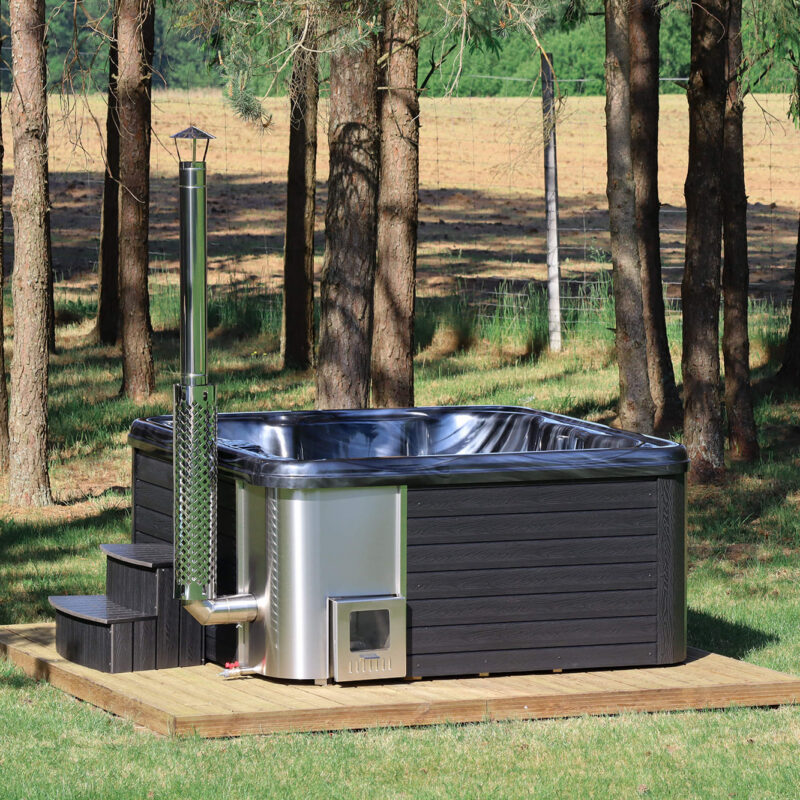
Take a natural-look tub, add hydro jets, air massage, LEDs and filtration, and you’ve got a spa that photographs beautifully and carries a fat margin. This is where you make real money per unit. Memelwood’s jacuzzi range is a good reference point for what the category should look like.
- Pros: High perceived value, strong margin, obvious upsell
- Cons: More moving parts to service; needs power on site
- Price: €5,500–9,000+
- Best for: Premium homeowners, wellness brands, four- and five-star hospitality
5. Square or Octagonal Family Tub (6–8 People)
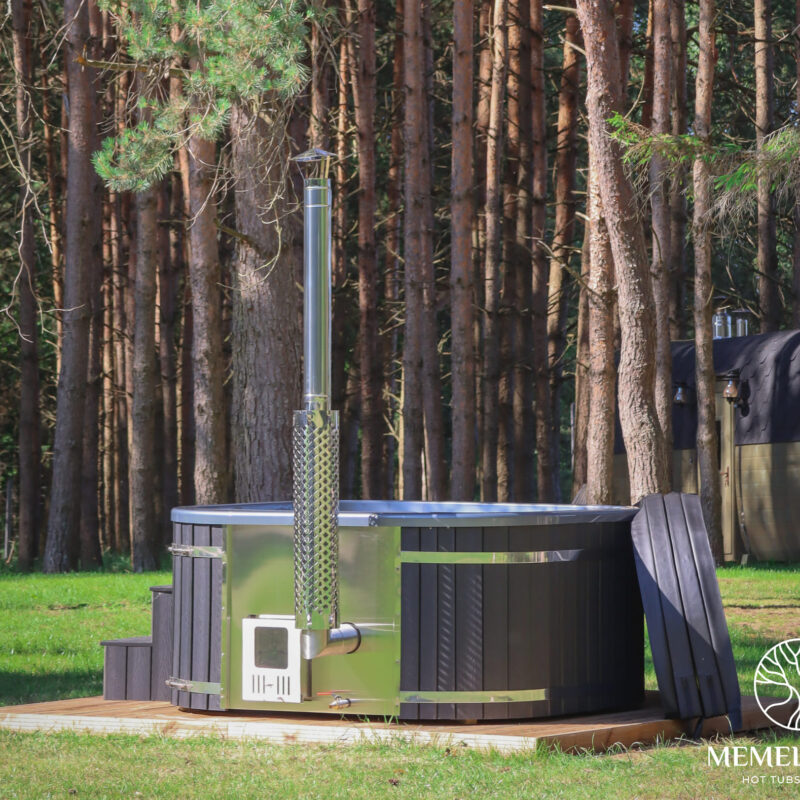
When the end user wants to fit the whole family or a group of friends, geometry beats the round barrel. These larger fibreglass and acrylic models seat six to eight and sell themselves for shared spaces.
- Pros: Big capacity, sociable layout, glamping favourite
- Cons: Large footprint, slower to heat, pricier to freight
- Price: €4,000–7,500
- Best for: Glamping pods, holiday lets, larger households
6. Compact 2–3 Person Tub and Ofuro Baths
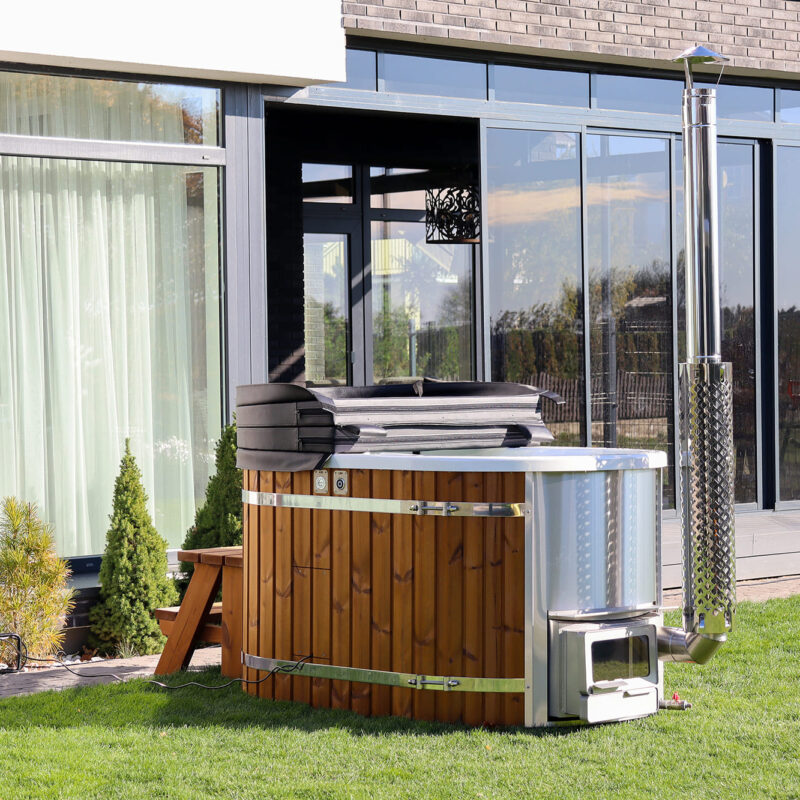
Not every plot has room for a six-seater. Small round tubs and Japanese-style ofuro soaking baths fit balconies, courtyards and single glamping units, and they use far less water and firewood.
- Pros: Fits tight spaces, cheap to run, heats fast
- Cons: Limited seating; less of a group centrepiece
- Price: €2,500–4,500
- Best for: Urban buyers, balconies, single-occupancy rentals
7. Acrylic Electric / Heat-Pump Spa
Not wood-fired at all, and that’s the point. A plug-in acrylic spa with an insulated cabinet, electric or heat-pump heating and smart controls covers the customers who want the water hot on demand with zero effort. If you sell to grid-connected sites, you need one of these in the range.
- Pros: Always-ready temperature, quiet, familiar to mainstream buyers
- Cons: Pricey to run without a heat pump; needs a proper electrical supply
- Price: €5,000–12,000+
- Best for: Hotels and homeowners who choose convenience over the fire-tending ritual
8. External-Stove / Off-Grid Wood-Fired Tub
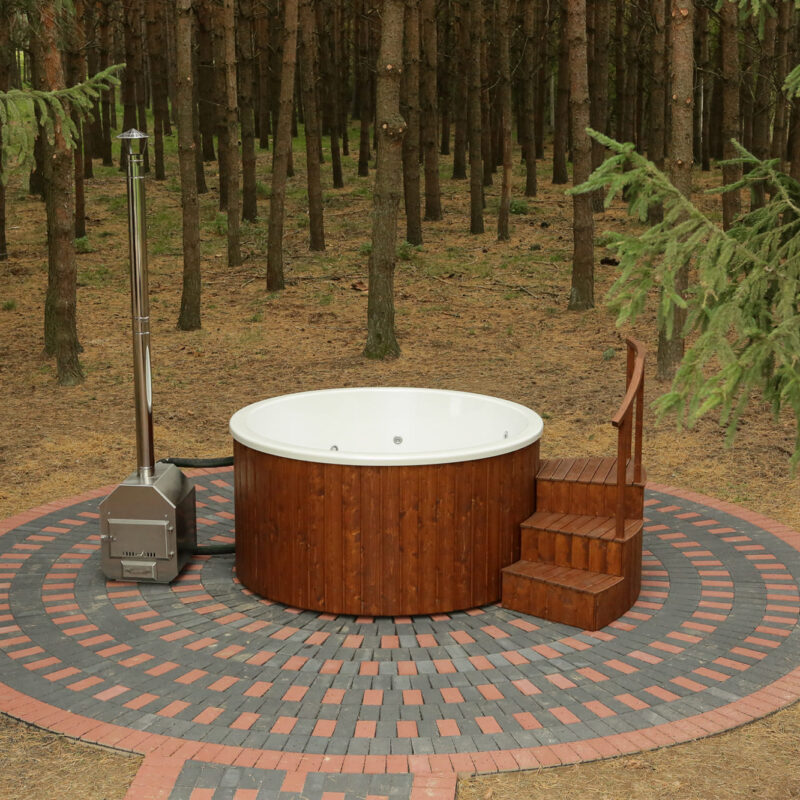
Mount the stove outside the tub and you free up bathing space and take away the risk of someone brushing a hot unit. No electricity required, which is exactly what off-grid sites need.
- Pros: Truly off-grid, more room inside, safer stove placement
- Cons: External stove eats space; some designs heat slower than a big internal unit
- Price: €3,000–5,500
- Best for: Remote cabins, off-grid retreats, rural glamping
9. Cold Plunge / Ice Bath — The Easy Add-On
Cold-water therapy went from fringe to mainstream fast, and plunges attach to hot tub sales almost automatically. Low unit cost, on-trend, and a simple way to bump your average order value.
- Pros: Trendy, cheap to stock, high attach rate, appeals to gyms and spas
- Cons: Smaller audience than hot tubs; chiller versions cost more
- Price: €800–3,000 (more with a chiller)
- Best for: Wellness retailers, gyms, recovery-focused customers
10. Custom and Private-Label Units
This one’s a capability, not a single product. Made-to-order sizes, cladding, liner colours and heater setups — often with your own branding on them. It’s how serious distributors stop competing on price and start owning a range. It only works if the factory can genuinely handle OEM without blowing lead times. Memelwood’s made-to-order and wholesale side is built around exactly this.
- Pros: Better margins, brand ownership, specs tailored to hospitality jobs
- Cons: Needs a real manufacturing partner; usually a minimum volume
- Price: Quote-based, typically from €4,000+ per unit
- Best for: Established distributors and hotel groups building their own line
Quick Comparison
| Rank | Product Type | Key Feature | Best For | Price (approx.) |
|---|---|---|---|---|
| 1 | Lined round + thermowood | Durable liner, natural look | Catalogue hero | €3,500–6,500 |
| 2 | All-timber spruce | Cheapest, authentic | Budget retail | €2,000–3,500 |
| 3 | Premium thermowood + stove | Longevity, low upkeep | Upmarket, cold climates | €4,500–7,500 |
| 4 | Wood-fired jacuzzi | Spa experience | Premium homes & hotels | €5,500–9,000+ |
| 5 | Square/octagonal (6–8p) | High capacity | Glamping & lets | €4,000–7,500 |
| 6 | Compact tub / ofuro | Small footprint | Balconies, single units | €2,500–4,500 |
| 7 | Electric/heat-pump spa | On-demand heat | Grid-connected sites | €5,000–12,000+ |
| 8 | External-stove off-grid | No power needed | Remote sites | €3,000–5,500 |
| 9 | Cold plunge / ice bath | On-trend add-on | Gyms, spas, wellness | €800–3,000 |
| 10 | Custom / private-label | Bespoke + branding | Established B2B | From €4,000+ |
How to Vet a Wholesale Supplier
The product is only half the deal. The supplier is the other half, and it’s the half that costs you money when it goes wrong. Here’s what experienced procurement people actually check.
Materials. Get specifics, not marketing words. Thermowood is stable and rot-resistant; spruce is cheaper but wants annual treatment; larch weathers to a nice silver-grey on its own. On the inside, ask about shell thickness and whether the liner is certified fibreglass or acrylic — that’s what keeps a tub watertight for a decade or more.
Heating. Wood, electric or heat-pump each fit different sites. For stoves, ask the steel grade (304 stainless is the benchmark), firebox size and heat-up time. For electric and heat-pump spas, push for real running-cost numbers, not just a kW figure on a spec sheet.
CE and paperwork. Anything sold in the EU needs CE marking and the relevant EN standards, with documentation to match. Insist on CE declarations, manuals in the right language and full technical files — especially from factories outside the EU, where “CE-ish” claims are common and need checking model by model.
Wholesale terms and MOQs. Good manufacturers price in tiers by annual volume, so walk in with a realistic first-year forecast — it changes the deal. Nail down minimum order quantities early; some ship from a single unit, others want a full pallet or container.
Logistics. Tubs are big and breakable. Ask about pallet configuration (many travel on a Euro pallet, laid on their side), packaging and whether the supplier already runs freight to your market. For deliveries outside the EU, agree who covers VAT and customs.
Warranty and parts. Two years is the industry benchmark; less is a warning sign for commercial use. And a warranty means nothing if you can’t get a replacement heater for six weeks — check that parts are stocked and support speaks your language.
If you want to see how a European factory lays all this out, Memelwood’s about page covers the production and export side, and their team fields spec questions directly through contacts.
The Bottom Line
You don’t need forty products. You need the right handful. Stock a lined thermowood round tub as your hero (#1), a compact unit for small sites (#6), and a jetted jacuzzi to catch the top end (#4), then bolt on a cold plunge (#9) as a cheap, on-trend upsell. That covers most of the market with four SKUs.
On sourcing, the case for buying European is hard to argue with if you’re selling into Europe: the designs suit the climate, the freight is shorter and more reliable, and CE compliance is baked in rather than bolted on. Baltic and Nordic makers — Memelwood, Kirami, Baltresto, Skargards — cover everything from purely traditional wooden barrels to modern hybrids and private-label lines. Shortlist two or three, ask for CE docs and a sample, and judge them on lead times and parts support as much as price. Browse a full range to see where your gaps are on the all hot tubs page, and take it from there.
FAQ
Wooden or fibreglass-lined — what’s the real difference?
A pure wooden tub is all timber: authentic, cheaper, but higher maintenance and usually good for 10–20 years. A lined tub keeps the wood exterior but adds an inner shell that won’t leak and wipes clean, which stretches the usable life well beyond that.
Wood-fired or electric for hotels and glamping?
Depends on the site. Wood-fired suits off-grid and rustic settings and gives guests a proper ritual, but someone has to load and tend it. Electric or heat-pump spas stay hot on a thermostat, which staff-run properties prefer. Plenty of operators stock both.
What should I budget per unit at wholesale?
Retail runs from about €2,000 for a basic spruce tub to €9,000+ for a fully jetted model. Wholesale is lower and volume-driven, so build a first-year order forecast before you negotiate — it decides which price tier you land in.
Do I need CE certification to sell in the EU?
Yes. EU-market tubs must carry CE marking and meet the relevant EN standards, with the paperwork to prove it. Always ask for CE declarations per model, particularly from non-EU factories.
Are cold plunges worth carrying alongside hot tubs?
More and more, yes. Cold-water therapy demand is climbing across Europe, units are cheap to stock, and they attach naturally to hot tub sales — an easy lift to average order value without much inventory risk.
Prices and market figures are approximate and vary by spec, region, currency and supplier. Confirm live wholesale quotes and CE documentation with the manufacturer before ordering.