
If you’ve been following the outdoor wellness market over the past few years, you’ve probably noticed how quickly barrel saunas — those round, barrel-shaped structures — have spread across gardens in Germany, the Netherlands, Scandinavia, and increasingly Southern Europe. What’s interesting is that a large share of them are actually manufactured in Lithuania. A country with centuries of woodworking tradition has quietly become one of Europe’s leading barrel sauna exporters, and most Western European owners have no idea their backyard sauna was built there.
In this article we’ll look at what’s actually behind the barrel sauna’s construction, why Lithuania became such a strong player in this niche, and what to check before choosing one for your own garden.
What a barrel sauna is, and where the shape comes from
The shape we now call a “barrel sauna” historically comes from wine and spirit aging barrels. The round body has a simple but very effective property: heat distributes more evenly inside than in a rectangular structure, since there are no corners where air stalls or cold pockets form. That means faster heat-up and a more even temperature throughout the room, floor to ceiling.
Practically speaking, the round shape also sheds rain and snow better — water simply runs off, rather than pooling on flat surfaces the way it does on traditional rectangular sauna cabins.
Why Lithuania became one of the biggest manufacturers
The answer is fairly simple: raw material and experience. Lithuania has large stands of pine and spruce, and local wood-processing companies have spent decades refining drying, impregnation and heat-treatment techniques. Thermowood — timber heat-treated at high temperature with no chemical additives — has become the standard, since it resists moisture better, is far less prone to rot, and needs less frequent upkeep than untreated pine.
Cost plays a role too. Compared to German or Scandinavian manufacturers, Lithuanian factories can offer a comparable-quality product at a noticeably lower price, since labor and timber costs are lower. That’s a big reason so many Western European distributors import saunas from here and resell them under their own brand.
Construction details worth knowing before you buy
Not every barrel sauna is built the same way, even when they look similar from the outside. First, wall thickness. Quality saunas use logs or panels at least 40–45 mm thick, while cheaper models sometimes go down to 28–35 mm, which means weaker insulation and a longer heat-up time.
Second, flooring material. Most manufacturers use 18–20 mm boards, treated to withstand constant exposure to moisture and heat. Third, roofing. Bitumen shingle is the standard, though some manufacturers also offer wood shingle (usually aspen), which looks more authentic but needs more maintenance.
And finally, the door. Glass doors with thermally insulated glazing lose less heat than they might appear to, and self-closing hinges are a small but genuinely useful detail — they stop heat from leaking out through a door left open by accident.
Heating systems: wood-fired or electric
This choice usually comes down to where and how the sauna will actually be used. Wood-fired heaters, like the ones offered by Finnish manufacturer Harvia, give you the authentic sauna experience — a live flame, natural scent, and no dependence on the electrical grid. That’s popular in countryside homes, near lakes, or anywhere a power hookup is impractical, or where people simply want the classic ritual.
Electric heaters, on the other hand, let you control temperature precisely, heat up faster in urban or suburban settings where power is already connected, and don’t require storing firewood. Hybrid units that can run either way, depending on the season or occasion, are becoming more common too.
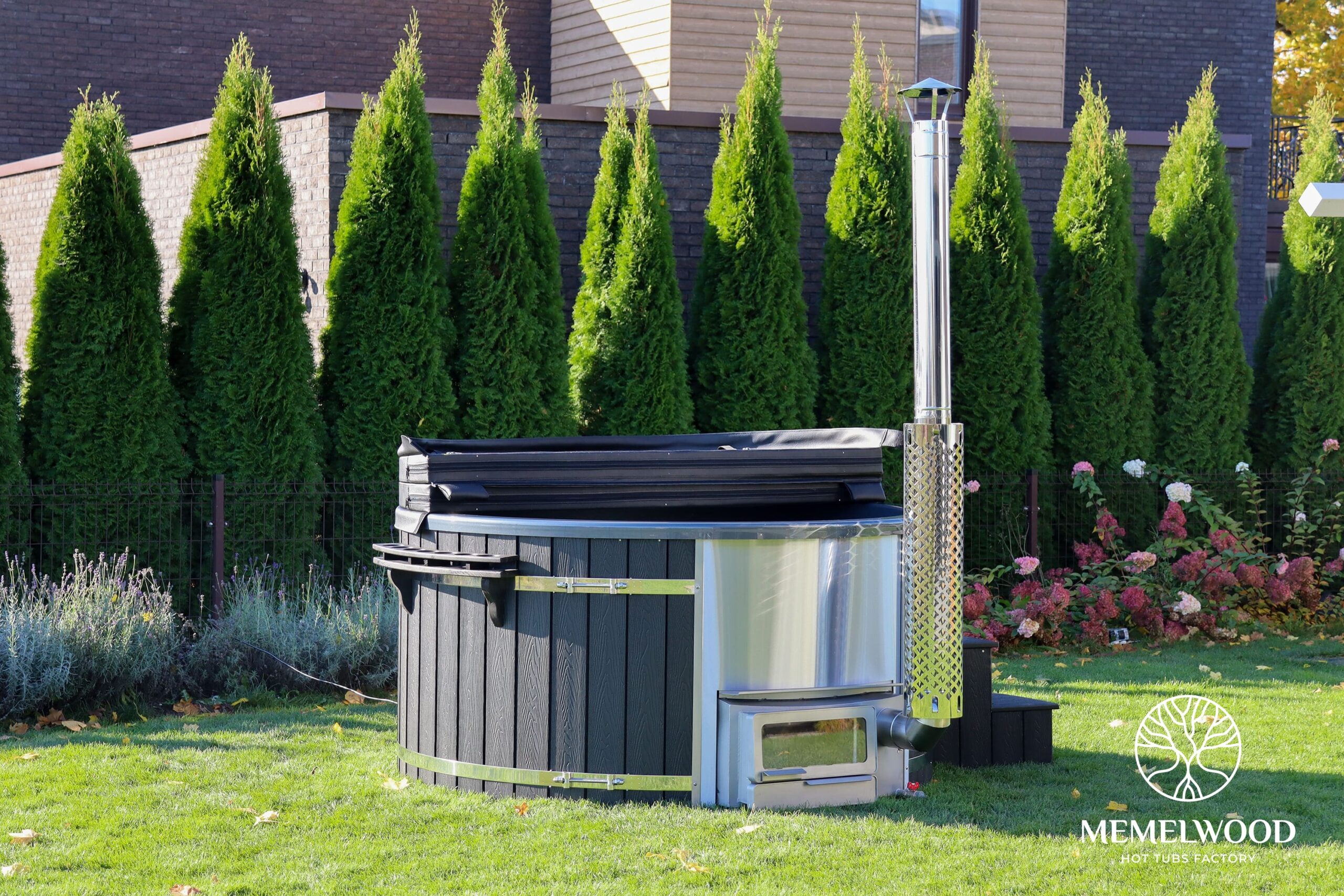
It’s worth noting the same heating logic applies to hot tubs — Memelwood’s hot tub range also offers both integrated and external wood-fired heaters, depending on how much seating space you want to keep.
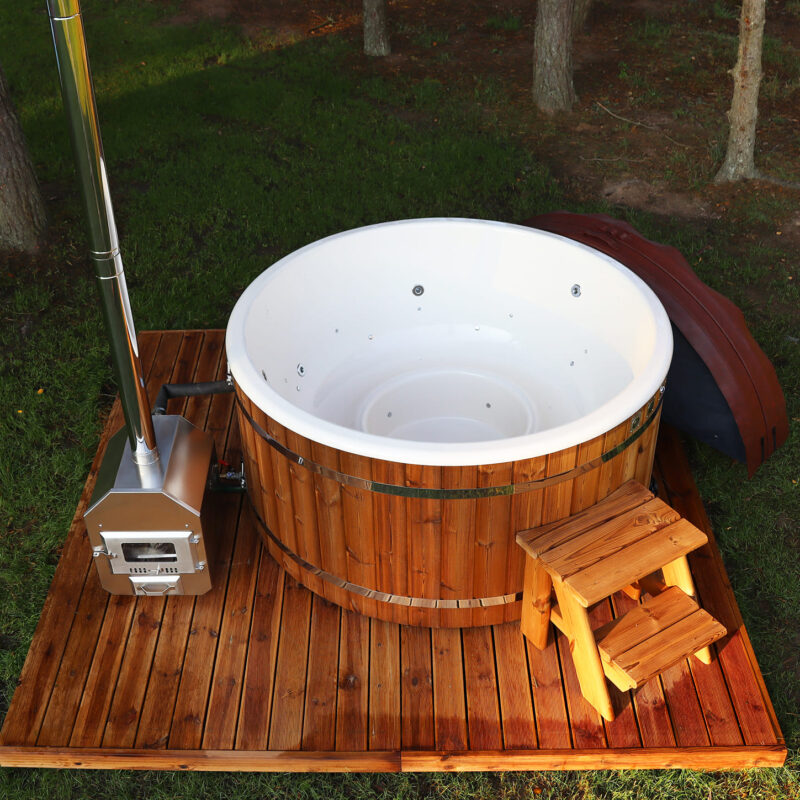
The same thermowood cladding used in saunas often shows up on the outside of hot tubs too (photo: Memelwood)
Sizes and capacity
Standard barrel sauna diameters range from about 1.97 m to 2.4 m, and the length depends on how many people need to fit inside. The smallest models seat 2–3 people and are usually chosen for compact urban gardens or terraces. Mid-sized saunas, around 3.5–4 m long, comfortably fit 4–6 people and often include a separate changing area at the front. Larger, commercial-grade models built for hotels or glamping sites can reach 6–8 meters and hold up to 8–10 people at once.
When choosing a size, it’s worth thinking beyond how many people will use it at once — transport and installation logistics matter too. Larger structures often need a crane, or at minimum several extra hands, to unload.
Sauna, hot tub, or both?
More and more owners today aren’t choosing between a sauna and a hot tub — they’re building both, and there’s a solid reason why. Hot-and-cold contrast therapy (heating up in the sauna, then cooling off in cold water or even a cold-filled hot tub) has become one of the fastest-growing wellness trends in Europe in recent years, since the ritual boosts circulation and speeds up recovery after physical activity.
If you’re planning this combination for your own garden, it’s worth thinking about layout early — the sauna and hot tub should sit close enough that you’re not losing heat walking between them, but far enough apart that moisture from the tub doesn’t damage the wooden sauna structure. If you’re weighing up the hot tub side of that equation, Memelwood’s acrylic hot tub collection is a good starting point — it pairs thermowood or WPC cladding with a durable acrylic interior, so it sits visually well alongside a wooden sauna.
Maintenance: keeping a sauna running for decades
A wooden structure needs different upkeep than an acrylic or fiberglass hot tub, so it’s worth knowing the basics. First, exterior treatment. Even thermowood benefits over time from an extra coat of oil, which protects against UV and moisture — recommended once a year, or more often if the sauna sits in a very sunny spot.
Second, ventilation. After every use, it’s worth airing the sauna out briefly so moisture doesn’t stay trapped inside — this is the single biggest factor in whether the wood stays looking good or starts greying and rotting over time. Third, heater upkeep — wood-fired heaters need regular ash removal and chimney checks, while electric units need periodic stone replacement, since over time they lose their ability to retain heat.
Transport and installation: what to expect
A lot of first-time buyers are surprised to learn that barrel saunas usually arrive fully assembled rather than as a flat-pack kit. That has both upsides and downsides. The upside: no weekend spent buried in an instruction manual. The downside: transport requires a truck with a crane, or at least enough space for a trailer to maneuver, and the structure itself — depending on size — can weigh anywhere from 400 kg to well over a ton.
Before ordering, it’s worth checking the access route in advance — can a truck actually reach the spot, is there room to unload, will the unit need to be manually carried through a narrow path or gate. Reputable manufacturers ask these questions before production even starts, because surprises on delivery day cost more than planning ahead ever does.
The base should also be prepared in advance. While a heavy concrete foundation usually isn’t necessary, the ground underneath needs to be level and well-drained — otherwise the frame can settle unevenly over time, putting uneven stress on the wooden structure.
Common mistakes when choosing a barrel sauna
The first mistake is choosing based on photos alone. Two saunas can look identical in an online catalog while differing in wall thickness, timber species, or heater output. Always ask for exact written specifications rather than relying on a general product description.
The second mistake is undersizing the heater for a large sauna. If heater output doesn’t match the room’s volume, the sauna either never reaches the desired temperature, or takes unreasonably long to get there — which in turn drives up fuel or electricity costs. A reputable manufacturer should always specify recommended heater output for a given sauna size.
The third mistake is choosing cheap timber purely on price. Untreated or low-grade pine can look similar to thermowood for the first year or two, but it starts greying faster, shrinks with moisture exposure, and needs maintenance more often. Over the long run, the price difference often pays for itself in avoided upkeep costs.
And fourth — ignoring the warranty. Reputable manufacturers offer at least a two-year warranty on the structure, and some offer longer. If a seller avoids discussing warranty terms, or there isn’t one at all, that’s usually a sign to look elsewhere.
Frequently asked questions
How long does a barrel sauna take to heat up?
Depending on size and heater power, an average sauna reaches 70–90°C in 30–60 minutes. Smaller models with a more powerful heater heat up faster.
Can a barrel sauna be used year-round?
Yes, provided the walls are thick enough and the insulation is good. Heat-up takes a bit longer in winter, but the round shape helps retain heat more efficiently than rectangular structures.
How long does a wooden barrel sauna last?
With proper upkeep, a sauna built from quality thermowood can last 20–25 years or more. The heater and any electronics usually need updating sooner than the structure itself.
Does a barrel sauna need a foundation?
Usually a level, well-drained base — concrete piers, gravel, or a wooden platform — is enough. A heavy foundation like a permanent building typically isn’t necessary, since the sauna sits on a frame with skids or wheels.
What’s next
A barrel sauna is one of those rare purchases that works both as a practical investment in wellbeing and as a genuine visual centerpiece for a backyard. When choosing a manufacturer, look beyond price alone — check timber thickness, heater quality, and whether the company actually manufactures the product rather than just reselling someone else’s.
If you’re considering a sauna-and-hot-tub combination for your garden, the Memelwood team has been manufacturing hot tubs in Lithuania for over a decade, exporting to 22 European countries — it’s worth getting in touch for a custom quote, or browsing the full product catalogue.